

Bill Regulating Indiana Med Spas Has Passed: What You Need to Know and Why Collective Advocacy Matters

In Indiana, a senate bill regulating med spas and GLP-1 compounding recently passed and was signed into law. Here’s what comes next with IN SB 282: rulemaking, enforcement decisions, defining broad language.
This was one of several near-identical bills in state houses across the country, so don’t look away if you’re in the South (Florida), West (Arizona, Colorado), Midwest (Iowa) or East Coast (Massachusetts). For med spa owners, injectors, and private equity expanding into these spaces, the decisions made here may soon follow. If you needed a reason to tune in to AmSpa’s legal updates, here’s a big one.
Practices that are connected through AmSpa will be better protected, better informed, and better represented as med spa regulations move from law to lived reality. AmSpa membership gives you access to vital legislative updates, analysis of how these med spa laws may impact your livelihood, and a unified voice at the state level when it matters most.

Lexi Yoo, NP, (right) was one of the Indiana practitioners who spoke up on behalf of the industry alongside AmSpa’s Alex Thiersch, JD, during committee meetings for SB 282. Together with Yoo, we are building an Indiana state chapter of the American Med Spa Assocation. Will you join your fellow Hoosiers and make your voice heard?
Indiana SB 282 FAQ for Med Spas
In a recent AmSpa-hosted webinar, Indiana providers came together to break down what the final bill actually says, what still needs to be clarified, and where med spas still have the opportunity to influence the final outcome. Here are some of the key takeaways from that discussion.
What just happened?
- Indiana SB 282 has passed both legislative chambers and been signed into law.
- The law itself is final, but how it works in practice will be determined during the rulemaking phase.
When does the law take effect?
- The law goes into effect July 1, 2026.
- Registration requirements are expected to begin January 2027, after rules are finalized.
Is this just an Indiana issue?
- No. Similar legislation is currently pending in multiple states.
- Indiana is one of several test cases that other legislatures may look to when drafting their own laws.
What happens next?
- The Indiana Medical Board and Board of Pharmacy will create rules that define how the law is implemented and enforced.
- Many of the most important details will be decided during this phase, not in the statute itself.
What still needs clarification?
- What qualifies as a “responsible practitioner”
- How often that practitioner must be on-site
- What defines a “physician’s office” versus a non-physician-owned practice
- How registration will work for co-owned, rented, or nontraditional locations
- How exemptions will be interpreted
What is a “responsible practitioner”?
- Every registered med spa must have a physician, NP, or PA publicly listed as responsible for treatments.
- That practitioner must know what services are being provided and who is performing them.
- There is no defined minimum time-on-site requirement yet.
Who is most likely to feel the impact?
- RN-owned practices operating with limited oversight
- Mobile or home-based med spa businesses
- Practices relying heavily on remote or absentee medical directors
Can mobile or home-based services continue?
- Mobile treatments and at-home services will be difficult under the law as written.
- Treatments are intended to occur in registered clinical locations.
- Home-based practices may be allowed only if the location can be registered as a medical clinic.
Does this affect lasers, RF, and energy-based devices?
- Yes. The law applies to injectables, lasers, RF, and other medical aesthetic treatments equally.
- Delegation is still allowed, but appropriate medical oversight is required.
Can good faith exams be delegated to non-prescribers?
- No. Good faith exams must be performed by a prescriber: MD, DO, NP, or PA.
- RNs cannot perform GFEs under this law.
What about telehealth?
- Telehealth may still be used for certain components of care.
- However, the law anticipates some level of physical, on-site practitioner involvement.
Why does advocacy matter right now?


- Rulemaking can significantly expand or restrict how this law is enforced.
- Without industry participation, regulators will make decisions without real-world med spa input.
How does AmSpa help?
- National tracking of similar legislation across states
- Legal interpretation and compliance guidance
- Direct engagement with medical boards and regulators
- Organized advocacy at both national and state levels
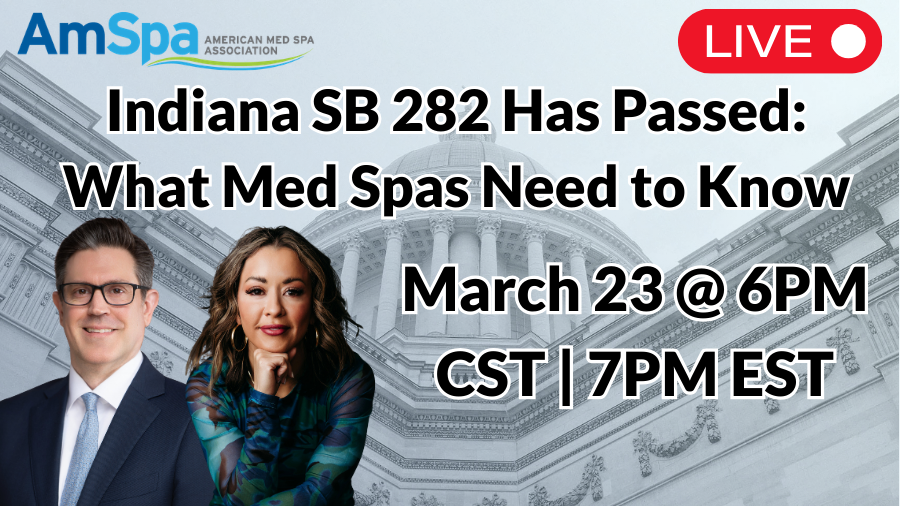
Webinar Transcript
AmSpa’s founder and chairman Alex Thiersch, JD, speaks with Lexi Yoo, NP, CEO of Yoo Direct Health in Noblesville, Indiana. Watch this free webinar: IN SB 282 Has Passed: What Med Spas Need to Know.
Alex Thiersch (AT): Well, welcome everybody.
Lexi Yoo (LY): Yeah, welcome, welcome. Thank you everyone for participated and dropped the questions. So if you don’t know who I am, I’m Lexi. I am a nurse practitioner out of Noblesville, Indiana. So I am a functional medicine nurse practitioner and I also do aesthetics.I have been doing, I’ve been a nurse practitioner going into my 15th year, so I’m not new to being a nurse practitioner. I am also a trainer for Galderma, so I’m very familiar with aesthetics.
I do inject as well. I focus a lot more on the hormone side, the wellness side, which, you know, we have a lot of women who once we get them feeling better, they want to look better.
So this is kind of how I got into this industry. And what my goal is to bring Alex to the table and many of the injectors because I feel like when this bill came about, we were just like sitting ducks. And we didn’t really have anyone to kind of organize us or to kind of get us in formation. So I’m not volunteering myself as the spokesperson for the Indiana Aesthetics crew. But what I can do pretty well is I know a lot of injectors and I know a lot of people and I can at least be an ear or someone to help maybe guide the situation.
Full disclosure, I do not own a med spa. And so I feel like I’ve reached out to a couple of people who do own med spas, and I feel like they add far more value than what I will. So I definitely want you guys, this is your meeting. I want you guys to be involved.
The only reason I got roped into this is because as soon as I heard that this was going to be affecting compounding, especially because we do a ton of compounding practices, we don’t compound within my practice, but we prescribe a lot of compounding. So it affects my business a lot. So that’s kind of how I got into it. But again, I don’t own a med spa. This meeting is for you guys. So I’m going to go ahead and turn the attention over to Alex.
About Alex and the American Med Spa Association
LY: So Alex, do you want to kind of say who you are, what you do and how you got roped into this?
AT: Yeah, no, of course. First of all, thank you, Lexi, for helping to put this together. You’re selling yourself way short. You’ve been a huge, huge help on this. And so we couldn’t have done it without you.
And just for those of you who don’t know me, I’m the founder and currently the chairman of American Med Spa Association. We are a nationwide association that represents med spas. We would love to talk more about what we do, but right now, the idea of this webinar is really to ensure that you all know what’s going on, you’re looped into the information. at least have as much information as we have. And then so that we can start kind of gearing up for the next steps. A few caveats.
And just for those of you who don’t know me too well, I am a practicing lawyer, although I no longer practice as much. I spend all my time doing AmSpa.
Our whole goal, especially now, what I’m doing right now is really trying to get folks like you to help and to buy in with us so that we can start providing some advocacy and some information on some of these bills, because there’s a lot of these that are happening across the country.
This is specific to Indiana, but there’s a ton of them that are happening, and it’s happening kind of fast and furious. And one of the things that we’re seeing right now, and Lexi, we can talk about this later, is as an industry, we’re not very united.
And so a lot of these bills are coming at us and we’re playing a lot of defense. Right now, currently, there’s like I wanna say, 10 pending bills across the country. We’re involved in all of them, but that’s, we have difficulty even doing that.
So I think the time is now for us to all unify together. That’s really what the main thrust of this is.
But for the specifics of the bill, we will go through kind of what it says, what some of the exceptions are. A big, huge caveat that I’m gonna have to throw out to everybody is, there’s still a long way to go in the process as far as what the final bill is going to look like. So we’re not going to, we’re going to have unfortunately a lot of, we’re not sure what that answer is yet. So there’s going to be a lot of questions that we just don’t have answers to quite yet. And that’s just nature of the process. It’s not that we’re trying to hold anything back or that it hasn’t happened yet. We just really don’t know yet.
And so, but that said, we’ve done a lot of work on this bill. I’ve had our lawyers look at it and provide their thoughts on it. So we’re pretty well versed in kind of what we can and cannot do, what it does say and what it doesn’t say. And the rest of it, we’re just going to have to figure out as we go.
But part of the reason we’re all gathered here is because we do want to make sure that we are involved in that next process, because that’s really going to be where the rubber meets the road, which is the rulemaking process.
How Lexi Got Involved in This Indiana Bill Advocacy
LY: Yeah, so just as Alex said, this is, to be honest with you, the more that I’ve researched this and talked, my husband has been very active, involved, and he’s not clinical, he’s a business owner.
So this bill affects our business. So that’s why he’s involved, why we’ve hired lobbyists, why we called Alex. Like this is why, like kind of like Alex said, we were literally like sitting ducks, just kind of like we had no troops, we had nothing to like help kind of guide us. And so unfortunately, it came on so quick, and it was like on the table, then they were gonna sign the bill.
So it did not give us time to like coordinate some information, to gather some lobbyists, to gather some funds, because that’s expensive. So do you wanna talk a little bit about, so I guess I have my own thoughts, but do you feel like, I feel like Indiana, they’re trying to make an example of Indiana, and I feel like this is kind of like, states are going to kind of follow what’s happening here in Indiana, in particularly because we’re in [Eli] Lilly’s backyard. And so I feel like it’s almost like we’re set to be made the example.
How These Med Spa Laws Are Spreading Across the Country
LY: And just as Alex said, there’s 10 other states that are trying to do the same thing. And I think they’re kind of like, well, how’s it going to pan out there? And then other states are going to mimic what’s going to happen here.
Alex, would you agree with that?
AT: Yeah, I think some, you know, some context is probably warranted in that there’s, you know, we’ve seen over the past year, 18 months, we’ve been very involved in trying to track this legislation.
So we track it all over the country. We were involved in doing lobbying in Texas when there was a bill introduced there. Some of you may have heard of that because that could have had some disastrous consequences.
But contextually, these bills are not being driven by people who understand med spas, know med spas, or even really support med spas, which is unfortunate. And this is kind of my original comment about us having a unified voice and coming together is based upon that because these things are starting to happen without us even having a seat at the table.
And that’s the issue, is that a lot of these bills are being, you mentioned Eli Lilly, this bill was originally prepared as a compounding bill to combat GLP-1s and the expansion of GLP-1s.
However, the Indiana legislature has also received a bunch of, I don’t want to say complaints, but they’ve heard a bunch of news about medical spas. And what we’re seeing right now is that medical spas are, for those of you who have seen any of the PR, there’s the John Oliver episode, there’s been a ton of articles. The PR that we’re getting is not great. And so these legislators are now saying, We need to do something, right? Something needs to be done to regulate med spas. They believe that med spas are back alley, dirty, like nail salons that also provide counterfeit Botox and everything else, right? That’s where we’re at.
And Lilly filed this bill, and they have a lot of funding, and they have filed about 10 simultaneous bills across the country. And to the extent that, yes, it is a test in Indiana, but more than that, it’s also just, they just want to get whatever passed they can get passed.
And they don’t really have much interest in, and this is not even to blame them, really, it’s not their business. They don’t have much interest in med spas themselves. They want to control the GLP-1s. And that’s the impact that they want to have.
So right now, we are fighting from behind because these things are happening.
They are being introduced. They’re being introduced in committee. A lot of them are being passed out of committee before we even find out about them. Because you have a company like Lilly, who’s got billions upon billions of dollars just to pay lobbyists, that becomes difficult. So that’s kind of some of the context of this. But the good news is, is that together we have the ability to fight all of these. I have no doubt. I have no doubt.
And Indiana, unfortunately, was kind of rammed through and it was a little bit, I don’t know, Lexi, it was a little depressing to see how the whole thing went down because there were like, on one hand, we were able to have an impact. We were able to talk to folks and make some meaningful changes. On the other hand, it’s like talking to a brick wall because people just, they’re not going to listen and they’re going to do whatever they want.
Helping Legislators Understand How Med Spas Operate
LY: Well, I think one of the most eye-opening things to me was when we were standing there, how little they knew. Like one of the questions I got asked in my testimony is, well, what medications are you compounding? And I’m like, we don’t compound anything.
And I gave them the definition about reconstitution, which if I’m injecting Sculptra, I’m going to reconstitute the Sculptra, which is unlabeled, but we do not compound.
So they had no idea.
And then when Alex went up there, he said, we’re looking at two separate things. You’re talking about compounding, and then we’re talking about aesthetic practices.
And so it was almost like their understanding was they thought we were actually compounding GLP-1s in practice.
One of the questions they asked me is, how many times have you been investigated?And I said, none.
Like, it’s just, so unfortunately, like, it’s almost like we were painted this picture of like, we’re just mixing compounds and slinging tox.
And it’s like, no, that’s not it. In the majority of practices, that’s not at all what’s going on at that level. And so unfortunately, we’re trying to get the bad actors out there. Unfortunately, there’s not a lot of police to do that, right?
AT: Yeah, that’s right. And believe it or not, the hearing that we were at, they knew a lot more than most legislatures. They had done their homework and they still didn’t know much of anything.
So I think your point though is well taken is that we’re talking to folks who don’t know the basics and they’re making laws. And in this particular situation, one of the sponsors of the bill was retiring. He was going to get something passed no matter what. And so something was going to pass. And so it’s, we’re kind of in this area where it’s like, all right, you’re almost mitigating damage at this point because you’re trying to keep out the really, really bad stuff. The only way we stop that is if we become more offensive.
And that’s what we’re doing as AmSpa is trying to spread out and get in front of these legislators early so we can stop it. But you’re dead on, it was an interesting experience.
You and your husband both did great, by the way. It was, and for everyone on the webinar, it was, these kinds of things are, there is still a need for involvement.
So as we talk, as we get towards the end, we’ll talk a little bit about the Indiana State chapter. And just from a kind of a process standpoint, right now this bill is officially law, right? So it’s become law, it’s been signed by the governor. But it’s not really going to take effect for some time. And by some time, I mean a couple of months.
And in the interim, the medical board and the board of pharmacy, hopefully with some involvement of the board of nursing, is going to create the rules that are going to implement this. And that’s kind of the next step.
And a lot of the decisions that are going to be made are going to be made in the rulemaking process, where we can have an impact by getting in front of the medical board, communicating with the medical board, saying with the nursing board and saying, ‘Hey, this is how we operate as an industry. So some of the things that are in the bill aren’t applicable. Let’s scale back or make a little bit of a different definition to it.’
At the same time, there’s also the opposite risk where some of the rules can be put in place that are more restrictive even that are in the bill. We’ve seen that happen in some states. So we do need to be involved. This is just the beginning of this and there’s going to be a lot more to come.
Bill Basics, Starting with the Timeline
LY: Yeah. So let’s get into the bill. So essentially, this bill came about early like January, the bill was introduced. And again, unfortunately, kind of like what Alex said in his testimony is we were clumped with compounding pharmacies. It was like med spas and compounding pharmacies almost became synonymous originally in this bill.
And then the compounding pharmacies started getting their lobbyists, did lots of testimony, and then they started kind of siphoning it out just a little bit more in detail.
But then when the bill that actually passed, it sounds like it removed all of the compounding part out of it and essentially what was left is if you are a non-physician owned practice that practices Aesthetics, Wellness, hormones, IV therapy, peptides, anything that they call wellness, you will be required to register by July 1st of this year.
So one of the questions was, if we’re required to register by July 1st, what happens from like July 1st until January of 2027 when it’s actually active if you’re not registered? Do we know?
AT: And actually, it’s a little more time than that. July 1st, the law takes effect. So the law goes into effect that there will then be a period where currently the medical board is working out what the registration process is going to be.
We don’t really have to be registered until the 1st of next year, 2027. The registration process is supposed to be done in October and then some medical spas can register January 1, 2027.
Now, all of that said, I have seen many, many times when these things get pushed because of deadlines and lack of things getting done. So it wouldn’t surprise me if this gets delayed a little bit. That happened in Illinois. It took two years for them to make these rules. Indiana is probably a little more efficient than Illinois is.
So what’s going to happen between now and then is the medical board is going to be figuring out to implement this registration process, right? What’s it going to say? How are you going to apply? What does it mean to be owned by a physician’s office, as opposed to a non physician office med spa?
There’s an exception in here about the not physician owned offices are not applicable to this bill. And that’s a bit confusing, because a lot of med spas are. They are owned by physicians, or at least tangentially owned by physicians. And so, does that create an exception? Does that create kind of a loophole?
There’s a lot of things we have to figure out. That’s the main thing that we’re going to be sifting through in the next six months is:
- What are these rules going to say?
- How are they going to say it?
- And what’s the actual impact going to be?
So when I say we don’t really know a ton yet about what the law is going to do, we know what it says, but really that’s only half the battle. It’s:
- How is it going to be enforced?
- How’s it going to be implemented?
- What are the details going to be?
That’s the thing that we need more clarity on, and that’s what’s going to happen in the next six months.
Responsible Practitioners: Present On Site a “Reasonable Amount of Time”
LY: One of the common questions that we’ve been getting in our Facebook group is when they define a, I think they say a responsible practitioner, you know, has to be present or has to be on site for, I think it’s a reasonable amount of time. Can you shed some light on exactly what they’re trying to say? And is a reasonable amount of time, like one day a month is that like, 50% of hours, I don’t think we know that quite yet.
AT: We don’t. And so there’s, there’s a few components of the bill. And that’s one of the ones that we absolutely need to address. And that is, there has to be a responsible practitioner at the med spa, right?
I do wanna say to everyone, for those of you who are practicing and you’re either used to working in a hospital or you’re used to working under a physician, most of this stuff isn’t going to necessarily impact or it shouldn’t impact kind of how you’re practicing.
I think that the issues we’re gonna have are gonna be with RNs who are doing things by themselves. Otherwise, there is no definition yet of how often you need to be on site or what even really a responsible practitioner is.
We know that it’s someone who knows the treatments. You have to know the treatments in the med spa. You have to know that everybody in the med spa who is being delegated treatments can do those treatments, in your opinion. A lot of that is really already contained when you think about standard of care, right, Lexi?
So it’s like, if you’re going to delegate a procedure, you have to know that the person you’re delegating to knows how to do the procedure. What the registration requires for the responsible practitioner is that you have to, out in the open, in public because you’re registering, say that ‘I know the treatments that are being done in the medical spa. And I know that the folks who are doing the treatments are qualified to do so.’
Those are the two things that are going to come out. And it is going to be they don’t really define what this means, but they say it’s a public registry. Which could arguably mean that the public could look up and find, okay, who’s the quote “medical director” at your med spa? And you’ll have to disclose that. You’ll have to make sure that it’s listed on there. And the purpose behind that is to make sure that we are being transparent with the fact that there are medical professionals. Hopefully what this will do is weed out and suss out some of the bad actors. That’s the whole point of this. That’s our goal. But that’s what the responsible practitioner side demands for this.
Working with a Medical Director as an RN in Indiana
LY: Yeah. So for the practices that are RN owned, but they have a medical director, perhaps offsite, what does this bill mean for those RNs? Or do we even know at this point?
AT: Well, we don’t really know, but, a couple things. One is you’re going to make—you should have a medical director anyway—but your medical director is going to have to be somebody who knows the business, at least in terms of the treatments, right? So, a lot of times, and this just kind of goes without saying, and it’s the nature of the industry, RNs are some of the best top injectors in the industry because they’ve been doing it. They do a lot of the training.
However, if you are running a business as an RN, you are going to have to have a responsible practitioner, that’s either a physician, an NP, or a PA, so therefore someone who can diagnose, who can delegate and who can prescribe. You’re going to have to have somebody who is responsible for the treatments, for providing the treatments, who is onsite a sufficient (or whatever that is) amount of time, right? And that is not going to be up to the RN, that has to be up to the actual responsible party.
And this may be the one group that’s going to be maybe impacted are RNs who are used to working independently. They are going to need to have somebody that they have a relationship with that understands the treatments, that knows how to do the treatments, that knows how to treat complications, which you should be doing anyway, arguably. So again, that’s the one piece of this that I think is going to be tough for some folks.
But it doesn’t define how much time the person has to spend at the med spa, right? And that’s really going to be a question of standard of care. So, if you’re a nurse practitioner like you are, Lexi, or if you’re a physician and you are the responsible practitioner of a med spa, it is up to you as the clinician to decide based upon your knowledge and experience how much time you need to spend at the med spa in order to properly supervise and to properly delegate and to properly know that the folks who are doing the treatments know what they’re doing. So, it’s going to be kind of like up to you, right? It’s up to you. But you’re going to have to be able to prove that if you do get investigated, if that makes sense.
Do Laser Techs Need a Responsible Practitioner On Site?
LY: Yeah. This kind of segues into the next question is, how does the Senate Bill 282, how will this impact delegation of like energy-based treatments? And you and I talked a little bit about the cosmetology board. So specifically, if there’s a licensed esthetician who is certified in lasers to perform RF microneedling and light CO2 treatments under the standing orders and established protocols, will this bill change what that is?
AT: Yeah, I mean, absolutely. So, if you’re an aesthetician who is helping doing lasers in Indiana, these laws and these bills, these rules all apply to lasers just as much as our energy devices, just as much as they do to injectables. So regardless of what your certification is or what you’re, where you’ve learned how to fire energy devices, you are going to need to have a responsible practitioner who is onsite a decent amount of time, who is the one providing good faith exams. So, meeting with the patient, creating the treatment plan, and then delegating it down to you so that you can then perform it. It shouldn’t impact the delegation itself. The only thing that’s gonna impact is what oversight is over you as the laser tech who is performing the treatment. You can’t just be doing this by yourself without involvement of a physician, an NP, or a PA. That person’s going to need to be on site. They’re going to need to be publicly registered also. And so that’s going to be some work for those of you who are trying to kind of operate independently.
The State Medical Board: Who They Are and What They Do
LY: Yeah. Next question was actually from Dr. Harper, which she was there when we did our testimony. So she has asked, when you say the medical board, can you state who that is? The elected board members or are there people that actually work for the medical board that will write the details of the bill?
AT: Great question, Dr. Harper. I wouldn’t be surprised if most of the heavy lifting is done by others besides those on the medical board. And what she’s referring to, for those who don’t know, but the medical board in most states in Indiana is a group of folks who are either appointed or elected, whatever it might be. And they are the ones with the ultimate authority in the medical board over the practice of medicine.
So, in the event that there is a vote that needs to be taken. They’ll be the ones to say, okay, this is what we’re going to do. Here’s what we’re going to do. Like any administration and any government, they’ve got a lot of folks who are going to be helping them. And that’s one of the areas where we come in is that we can help in that process of drafting the rules. So, you’re not going to see the medical board itself creating every last rule. What they are going to be doing though is reviewing it and they have the ultimate authority to approve it into what it says. So, ultimately, they are going to have to vote on it and the medical board will be voting on the version that is put in front of them. Sometimes they do hearings which allow other outside comments. Sometimes they allow written comments. All of that will happen and they will ultimately make a vote on the actual language. And that’s when it then gets implemented.
Defining Supervision and Delegation Requirements for Medical Practitioners
LY: Yeah. Another question, and I don’t know, Alex, if you’ve seen this in any of the other states that you’ve helped try to navigate this territory. What have other states done as far as like, there’s another RN, when they say they have to have a responsible person, involved, have you seen that as far as a time, a percentage of time, or have we not seen that to be defined at all yet?
AT: No, it’s usually not defined. And the reason it’s not defined is because the folks who are doing that are typically physicians, but they’re also NPs or PAs. And it’s really up to them, right? So, and it’s really difficult for the states to, and what the states don’t want to do—and I think this is one area where you’ll find this to be true in Indiana as well—the states don’t want to dictate to physicians how to practice medicine. And physicians are allowed, especially physicians, nurse practitioners are obviously governed by the Board of Nursing, but physicians are allowed to basically make medical decisions, including delegation decisions based upon their training, their experience as a physician.
And so, you’re probably not going to see anything written specifically that a responsible practitioner needs to be on site at least one, two, three hours a day, whatever it might be. The answer is going to be, and this is what we always tell folks, and this is not a good answer, but it’s the answer, is that you have to be on site or you have to have a responsible practitioner on site as much as is necessary to be safe.
And how do we know what that is? If the medical board is talking to the physician or if the nursing board is talking to the responsible practitioner, you have to be able to prove to the medical board or the nursing board that you have been operating under the standard of care. You’re on site enough to properly oversee, to properly delegate, to properly make the decisions. And so, it all kind of comes up to a, it’s just a judgment call on behalf of the person who’s actually there.
Why Mobile IV Therapy Is Threatened By This Bill
LY: Yeah. Next question is any idea how this bill may impact home-based IV therapy companies since it’s specific to no home treatments?
AT: Yeah, so again, there’s a few components of the bill. One is the registration, which you went through. Another component of it is kind of one of the biggest ones that’s the most clear, unfortunately, is the part that talks about home treatments.
And it’s unfortunately the one that probably is going to be the most difficult to overcome. So, what the law says is that basically any of these treatments must be done in a doctor’s office, in a clinical setting.
When I spoke with one of the folks in the legislature, this was something that they were really, really hell-bent on getting passed because they believe that there’s a lot of these, you know, quote unquote “Botox parties” going on, and they’re just so dangerous. There’s, they’re swimming with bacteria and all this kind of stuff. And they really think it’s this terrible, terrible thing.
So currently, it is going to be difficult to be able to do at-home treatments. Now, all of that said, all of that said, so mobile treatments are going to be difficult. We’re going to have to see how this pans out, but any type of mobile treatment is, from what we can see, going to be directly contrary to the law.
So mobile IV, that’s going to be a tough one. Anyone who’s doing on demand kind of bespoke mobile med spa treatments, whether it’s Botox or fillers, whatever it is, that’s going to be tough. What you are allowed to do, though, is register your locations. So what, of course, what all the lawyers are going to be doing is figuring out how we get around these by saying, okay, well, what if we register a location as our mobile IV van, right? Does that count?
Unclear. Those are the kinds of things that are gonna have to be worked out. That piece of it, though, is fairly well defined and sussed out, and that’s gonna be the biggest area that I think is gonna cause people some consternation and we’re going to have to have some change on because it does clearly say, and they said that they do not want folks doing med spa treatments outside of a physician’s office. That’s the whole point of it. So that’s going to be tough. We’ll have to figure out that and we’ll have to have some input into the rules for that as well.
Can Home Offices Work for Indiana Med Spas?
LY: So I know that there’s a couple of practitioners who work from their home, like they inject from their home. Do you feel like this bill will essentially get rid of that as an option?
AT: It’s unclear. And I hate, again, I hate saying that, but potentially is what I would say. Potentially. It depends on what the final rule says. What you would have to do if you operate from home is you would have to register your home as a medical clinic. So, when you register your med spa locations, one of the locations would have to be your home. And if you could do that, and it was properly registered, and during this process the medical board says it’s okay to do that, then you can treat people out of your home.
What they want is, they want wherever you’re treating to be set up like a physician’s, like a doctor’s clinic or a medical clinic. So you have all the tools that are in place to be able to counteract side effects, bad outcomes, whatever it might be. That is probably more likely to be able to do treatments out of your home if you can register that location. That’s more likely than just to have a pure mobile business where you’re going from different places to different places. Because in that situation, you’d have to register every place that you went and treated, and that’s just not going to happen.

Who Needs to Perform the Good Faith Exam?
LY: Next question is more going back to the responsible practitioner. And again, what’s hard is we still haven’t defined what that is, but will the responsible practitioner, do they have to also be the one to clear for good faith exams? Or like, I know that there are some practitioners who use like a telehealth service. Does the responsible practitioner have to be the same as the person doing the GFE?
AT: Good. Another great question. Unclear. My interpretation is that they seem to be separate things. The responsible practitioner is a responsible practitioner, but that doesn’t mean you can’t have others who are doing the GFE, or you could have a responsible practitioner and then also have an NP or a PA who is doing diagnoses and GFEs themselves.
That’s the way that I anticipate it going, because that’s how medicine is practiced. So I don’t think that they’re going to mess with that. I do think, however, the responsible practitioner is going to have to be responsible for the treatments that are occurring, even though the GFE is done, let’s say by telemedicine or remotely, right?
You’re the responsible practitioners, you need to know that’s happening. They’re going to know what the protocols are. They can’t be absentee landlords. That’s the main thing.
How to Register When You Rent a Suite
LY: Yeah, unfortunately, I think that’s still going to develop. What about med spas, they’re not technically a med spa, but they maybe rent a space out of a salon. Do you feel like that is still going to fly or is that going to also be scrutinized?
AT: Again, unclear. We don’t have the answer to that. What would have to happen is you’re going to have to register your location as the med spa. So if you’re renting space, and this is not atypical, so I don’t imagine this would be necessarily a problem because people rent space all the time.
The issue is going to be what does the registration component require? And will they make any limitations on things like that? Like, will they say, ‘OK, you can register your med spa but it has to be zoned as medical,’ right? Maybe they’ll say that. Or you can only have one primary location. A lot of states have done it in different ways.
But I wouldn’t say that’s foreclosed, because what you would be doing is you’d be registering that room, that location as your med spa, and that would be the address, the physical address that you’re putting in the registration paperwork that’s sent to the State.
LY: Yeah, which in order to get like Botox shipped to you, you can’t have that shipped to your house. Like you have to have it with like an address that is like your registered facility. So you know what I mean? Like, I almost feel like it’s probably going to be something similar to how you receive your product.
AT: Yes. And I think that’s kind of how we have to really think about this is that if they’re trying to, and what we are also trying to do as an industry is we’re trying to make this more of a normalized professional industry that is in line with other areas of medicine, because these are medical treatments that we’re practicing. So you have to make sure that you are doing everything medically.
So anytime you’ve got a responsible practitioner, let’s say a medical director that has 35 NPs working for them, right? And we’ve seen that before, or you have untrained people on site, like that’s what they’re trying to get at and what we’re trying to get at is how do you enforce those? And so really this is a way to define, hopefully define the good actors so we can get after the bad actors, that’s my hope.
Defining the Ownership Percentage in Physician-owned Practices
LY: Yeah. Have they ever defined what percentage of a practice has to be owned by a physician to be a physician-owned practice?
AT: No, they have not. And that is a really good question. And it was part of the debate that we were having with them was that it makes a world of difference, right? Makes a world of difference. I can see a setup here, and a lot of folks do MSOs, management service organizations, where you’ll have the backend clinic owned by the physician, but then you’ll have a lot of contracts and subcontracts. That’s technically a physician-owned practice. And I would argue as a lawyer, if you were hauled in front of the medical board under that method, that you are exempt because you’re operating through a doctor’s office.
But the question that we don’t know is what does it mean for co-owned, jointly owned practices? Unclear. My sense is that they are going to want physician offices to be fully owned by physicians. That’s the way that they’re looking at it. They’re looking at it as a doctor’s office owned by physicians, that’s exempt. Anything owned by others is not.
LY: Yeah. And I want to clarify when we’re saying like nurse practitioners, doctors, physician’s assistants, I would include in that they are also a prescriber when we talk about responsible parties. So that would be NPs, PAs, MDs, DOs.
Can Chiropractors Be Responsible Practitioners in Aesthetics?
LY: Another question that was brought on, what about the nurse practitioners who work out of a chiropractor facility?
And so I might actually answer this one a little bit. If you are working in a chiropractic facility, you should still have a collaborating physician who is a prescriber. So what, and feel free to correct me if I’m wrong, I would imagine you’re just going to take whatever that address is and register that with the state. In that you still have a medical director or you still have a collaborating physician that is your medical director. So even though you’re out of the chiropractic facility, I think that still counts as a facility.
AT: It’s better than operating out of your house probably at first. But you’re absolutely right, Lexi, chiropractors are restricted in what they can provide and perform. So you would still need another responsible party physician.
And even the chiropractors are considered physicians, like it’s different in these cases because their practice scope is restricted. Whereas physicians, NPs and PAs who are practicing medicine and DOs as well, they’re allowed to to diagnose and to prescribe and to delegate medical treatment that they’re considering in this bill.
So if you’re at a chiropractor’s office, you’re going to need another responsible practitioner, a medical director to be able to make those those types of prescriptions and orders.
Can an RN Use “Med” If They Work with an MD/DO?
LY: Yeah. And I think this next question goes to, I think there’s certain like verbiage that as an RN owned practice, you can’t use the word medicine in there. But the question is, if an RN calls the business an aesthetic business instead of a med spa, is that acceptable with an MD on site or does it have to be owned by an MD?
AT: No, so that’s a good question. It’s not really addressed by this law, but there is some confusion, and there was some confusion even by the legislators in this, is that should be OK if you’re either co-owned, jointly owned, or if the physician owns it and calls it an aesthetic practice, or if you own it and then you have a physician who is on site as your responsible practitioner and they’re the ones who [co-own]. If you’re compliant in all the other ways as far as the GFE and the delegation, that should be okay as far as I know.
I think what’s going to need to happen, though, is the physician that you have is going to need to register as the responsible practitioner. And I think one of the things they’re trying to do is to put some of the onus on the physicians or the NP, if you’re a PA, and say, okay, if you’re going to be a responsible practitioner, you’re going to have to take responsibility in that you’re going to put your name down and say, ‘I am responsible for X, Y, Z.’
And that’s where the physician or NP or PA is going to need to know what’s going on in the practice because they’re not going to want to do that, make those certifications, put their license at risk if they don’t know that everything is safe and above board and compliant. Does that make sense?
Can Responsible Practitioners Supervise via Telehealth?
LY: Yeah. I think we’ve kind of already asked answered the question, but just to confirm, will RN owned businesses be able to utilize telehealth with their medical directors and that be sufficient time with a medical director on site?
AT: Another good question. I don’t know, but I don’t believe, I think when they’re talking about on site, I don’t think they’re necessarily talking telehealth. I think you would probably still need to have a responsible practitioner on site. Meaning, again, that doesn’t mean 24 hours a day. It’s not defined. But you will have to have a practitioner on site.
That doesn’t mean, though, that you can’t supplement that with telehealth. And when the practitioner’s not there or really any time, but you’re still probably going to need to have somebody physically in person on site.
Why Good Faith Exams Need to Be Performed By Practitioners
LY: Yeah. So this next question is about the GFE. Can a GFE be delegated to an RN from a physician or does it always have to be a prescriber? So NP, PA, MD, DO.
AT: Yeah, it has to be a prescriber. The GFE is one thing that cannot be delegated, not because it couldn’t be delegated.
I mean, theoretically it could be done. But the issue there is that as an RN, your scope of practice is defined by your practice act, and you do not have the ability to prescribe, you don’t have the ability to make medical diagnosis. You can do nursing, but you can’t do medical diagnosis.
So the issue with that would be you’re exceeding your scope, and therefore the responsible practitioner who’s the physician would arguably be on the hook as well, because they’re overseeing somebody who’s exceeding their scope.
So you would definitely need the GFE to be done by NP, PA, DO or MD.
Can Dentists Be Responsible Practitioners If They’re Able to Inject?
LY: What do you feel the impact to a dentist operating a separate, an aesthetic practice performing injectables, energy-based devices, would that be considered physician owned or is she having to be the responsible practitioner? So would a dentist count in this definition?
AT: Again, unclear. From what I’ve seen from the law, though, no, I don’t think that it would. I don’t think a dentist can qualify as a responsible practitioner.
It doesn’t mean a dentist can’t own, but you’re still going to need to have a responsible practitioner on site. You’re going to need to have someone be able to do that GFE and be able to make a lot of, especially anything outside of the area of the mouth.
I mean, dentists are interesting because clearly, you can do these treatments around the mouth and anything related to a dental plan. But once you start getting to energy devices and other things that go outside of that, you’re falling into the medical spa definition and you’re absolutely going to need to be, I believe, need to be registered.
Now, I guess the caveat to that is, will they allow dental owned practices to be exempt? And that is something we don’t know, just because the whole exemption thing and the definition of exemption, which is physician-owned, isn’t defined yet.
It’s a good question.But I wouldn’t anticipate you’re going to need to have somebody there as well.
What Counts As a Physician Office?
LY: What about the language of the bill says physician’s office and not physician-owned practice? Can you talk a little bit about that?
AT: So, it’s a good question. And the reason I’m saying physician owned practice is because that’s kind of how they were defining it when they were talking about it.
It does say a physician’s office is exempt. What does that mean? Again, we don’t know yet. We just don’t know yet what that’s going to mean. If it’s going to have to do with ownership, is there going to be an actual definition to it?
Don’t know. My strong suspicion is though, is that what they are going to want is a traditional physician’s office, which is oftentimes, if not owned by physicians but at least it’s…
When they think of this, they think of a physician’s office like their general practitioner. There’s always physicians there. You know, you go see your doctor. That’s how they’re thinking of it. They’re not thinking of it in the way that we operate a lot, which is where you have doctors who are oftentimes overseeing off-site.
And that’s where the issue is gonna turn is how do they define it? As what’s a physician’s office versus what’s a non physician’s office? And we just don’t know yet.
Do Podiatrists Have the Scope to Supervise Med Spas in Indiana?
LY: Can a podiatrist count as a collaborating physician for aesthetics?
AT: I don’t think so. I think that would be tough. But that is not addressed certainly in this bill.
And that’s a very specific Indiana question, which we can absolutely find an answer for. My response to that would be proceed with caution, because again, podiatrists are, every provider is governed by their practice acts. And your practice act for a podiatrist relates to a certain area of the body.
Doesn’t mean it can’t be done. But the same thing with like chiropractors, dentists, you have restricted areas where you are supposed to be practicing. And once you get outside of that, it starts to get a little bit iffy. So I think that’s something we’ll have to find out for you, but my hunch is probably not.
Will Responsible Practitioners Make the Call on Unlicensed Injectors?
LY: What about, so in Indiana, aestheticians can inject. Do you foresee this bill impacting aestheticians or MAs who are injecting in some of these aesthetic practices?
AT: Potentially, potentially. I mean, again, I think what they want and what’s going to be what’s required now is that you, as an aesthetician, have to register the medical spa. And you have to have a responsible practitioner who’s willing to put his or her name on a document that’s filed with the medical board.
So that person is now responsible, right? They’re responsible for the patients. The issues with estheticians, not that you can’t inject necessarily. It’s, are you following all of the other protocols? Are you having a good faith exam? Are you having the proper delegation procedures? Is the person who’s on site or overseeing there enough where they can actually do a good job? Do they know the treatments? Do they know how to treat a complication?
That’s the key here. It’s not necessarily, you know, can an aesthetician inject? It’s much more how are you going to do that and fulfill the requirements of registration? And that’s where I think it might have a competence because you are going to need to now have a physician, an NP or a PA willing to basically oversee and supervise that practice. and put their name on something, knowing that they can actually get in trouble as well.
And that’s where I think you might run into the issue.
The Question of Compounded Peptides in a Med Spa Practice
LY: Can we talk about the impact on other compounded peptides and our ability to sell them to our patients? Can you discuss the peptides a little bit more?
My understanding based on the language is that anything from a compound or a research-based pharmacy that comes lipolyzed is considered compounding when reconstituted in the office. However, an FDA-approved medication is considered okay when reconstituted.
AT: First of all, I knew this question was coming. I was waiting for it. And we quickly kind of get outside my area of expertise.
And I will tell you this, that goes much more to the compounding side of the bill than the medical spa. And your question is a good one in that first of all, you can absolutely still do compounding if you are doing compounding properly.
You just need to make sure that you meet the requirements of the law when you’re doing it, which means there are, whether it’s FDA approved, what the reconstituting means, all the paperwork and stuff you have to actually track. All of that can be done. You just need to make sure that you’re doing it.
So the peptide question is going to be really difficult to tackle right now because it’s going to depend on what constitutes compounding. And they’re struggling with that already.
What I will tell you, though, is that most of the folks at the Board of Pharmacy and some of the legislators in the Board of Medicine that I’ve spoken with, it is something they want to be under the purview of compounding pharmacies.
Or if physicians are doing it, you’re taking the same types of steps as a compounding pharmacy would to be safe. So that opens up a whole kind of can of worms as far as how they’re going to approach that. And we just don’t really know at this point, which I know, non-answer. So I apologize for that, but we’ll get more on that soon because we’re definitely looking at it.
LY: So I’m just going to kind of give some experience that I’ve had. So we’ve been using peptides for a very long time. I teach in peptides. I train in peptides to do all the things.
My suggestion is to be very careful with where you’re getting your peptides. So research-based peptides, we’ve talked, my husband and I have spoken to our attorneys multiple times about this, is making sure that what you’re using is for human use. And then not only that, if you can utilize a 503A compounding pharmacy, because not only are you taking on this liability as a prescriber, you can also now share that with whatever the regulations and rules and stipulations that a compounding pharmacy has to go to from potency, purity, batch testing, certificate of analysis.
So my recommendation would be, if you’re going to be prescribing peptides, I would really encourage you to utilize a 503A compounding pharmacy where it takes the reconstitution and all that stuff out of your hands and puts it in the pharmacy, which that is their specialty.
And they can either ship it to your patient or they pick it up or whatever. But I just, we’ve talked to our attorneys too much about peptides. And I would really caution you just to be a little bit more going into these things with your eyes wide open when it comes to who you’re sourcing your peptides with, because there’s a lot of scary stuff out there.
Why Now Is the Perfect Time to Join the Indiana State Chapter
LY: So Alex, can you talk a little bit about how we would want to get set up to put together like an Indiana AmSpa chapter?
AT: Yeah, yes, of course. And I think that’s what our focus is right now, because you can, I’m sure you can just tell if you can imagine these happening in 50 states.
We can’t do it sitting in Chicago doing all this. We need to have folks like you all, like Lexi, and folks who are wanting to leave to be able to get together and really kind of have a grassroots groundswell of support.
So we are going to, we will set up a state chapter and we need to get some folks who want to be interested in the leadership side.
LY: So we’ll be reaching out to get you guys into some sort of role, some scheduled meetings, whatever Alex and the AmSpa chapters recommend.
AT: Yep. And then from there, what we’ll do is we will provide updates, we’ll provide a certain amount of funding to the chapter.
But the idea is also to get more members on the state level, because the more members we get, the more obviously resources we can use toward putting towards lobbyists and things like that.
And then updates and meetings, whatever it is that you really want to do we can do, but we’ll have a kind of a playbook for you that you can follow.
But the main idea is to get everybody connected, to get everybody connected so that you’re all involved, you know what’s going on, you know. And even just this today is great because we’re educating people and you guys are learning. That’s the most important thing is just to make sure that we’re all connected and we know what’s going on so we can have a voice.
Follow-up with AmSpa and Its Legal Partners
LY: If you want to, if they want to reach out to AmSpa for some additional questions, is there an e-mail that we can, we can either contact us or something that we can put maybe in the chat or a follow up e-mail?
AT: Yeah. So, for sure, we want to get everybody involved. Members get to have access to all of our legal tools. They also get access to the lawyers at ByrdAdatto for a complimentary consultation. So you can’t actually talk with them about what you’re doing. More than that, though, we will be providing additional updates, certainly on this bill, what we’re doing.
The ideal would be to get folks like Lexi and some other folks who are engaged to be able to interact with the Board of Nursing, with the Board of Medicine so that we can get a lot of that that that that open line of communication.
But this is the first step, because if we don’t have a seat at the table, they’re going to make these rules without us. And I guarantee they’re not going to be what we like.
And that’s the reason that I, and like I say, I’m so grateful for you, for what you and your husband have done to put this together, because it’s hard. It’s hard to reach folks and it’s hard to get them on the same page. And we have to be on the same page. We have to have a unified voice.
Look for More News on Lexi’s and Alex’s Podcasts
LY: So Monday, I’m actually interviewing Alex on my podcast and then I’m supposed to be on his podcast. Alex, what’s your podcast called?
AT: Medical Spa Insider.
LY: Yeah. Mine is the Better You Project. And if you have any follow-up questions that we might be able to answer, it doesn’t sound like we’re able to answer a whole lot of anything, but we want to make everyone aware. I can ask those questions on the podcast.
AT: And let’s get them and I’ll submit them to our lawyers and we’ll get whatever answers we can. I don’t want to leave any question unanswered.
LY: Yeah, perfect. All right, everybody. Thank you so much.
AT: Thank you. More to come. Thank you for being involved, we appreciate it.
Join the Indiana AmSpa State Chapter
Indiana SB 282 highlights why local engagement matters. The Indiana State Chapter of the American Med Spa Association connects med spa professionals across the state to share updates, coordinate advocacy, and communicate directly with regulators during the rulemaking process.
By joining the state chapter, members gain early visibility into regulatory developments, opportunities to provide input, and a stronger, collective voice when engaging with the medical board, nursing board, and policymakers.

Share your interest in joining the Indiana State Chapter.